 English
F4 vs F5 Gate Valves: Dimensions, Differences & How to Choose
F4 and F5 are two common face-to-face dimension series used for flanged gate valves. The main difference between them is the valve’s face-to-face dimension. In simple terms, F4 is the shorter pattern, while F5 has a longer face-to-face length.
This article explains the key differences between F4 and F5 gate valves, including their standard dimensions, replacement considerations, and how to choose the right option for new installations and replacement projects.
What Does F4 Mean on a Gate Valve?
F4 is a common short-pattern face-to-face dimension used for gate valves. It originally comes from the DIN 3202 standard. In the current European standard system, DIN F4 generally corresponds to EN 558 Series 14.
Because F4 gate valves have a shorter face-to-face length, they offer a more compact installation and require less space in the piping system. This design is commonly used for ductile iron resilient seated gate valves, especially in water supply, water treatment, irrigation, and HVAC systems.

What Does F5 Mean on a Gate Valve?
F5 is a common long-pattern face-to-face dimension used for gate valves. In the current European standard system, DIN F5 generally corresponds to EN 558 Series 15.
Compared with F4, an F5 gate valve has a longer face-to-face length and therefore requires more installation space. F5 is also widely used for flanged gate valves, especially in projects where the existing piping system has already been designed for F5 / EN 558 Series 15 dimensions.

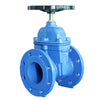
F5 Gate Valve
It is important to note that F4 and F5 only indicate the valve’s face-to-face dimension series. When purchasing a gate valve, you should also confirm other key specifications, including DN, PN, flange standard, body material, sealing type, and operating method.
F4 vs F5 Standard Face-to-Face Dimensions
The most obvious difference between F4 and F5 gate valves is the face-to-face dimension. For the same DN size, F4 has a shorter face-to-face length, while F5 has a longer one.
The table below shows the standard nominal face-to-face dimensions for F4 and F5 gate valves and can be used as a reference for valve selection and dimensional checks:
| DN | F4 / EN 558 Series 14 | F5 / EN 558 Series 15 |
|---|---|---|
| DN40 | 140 mm | 240 mm |
| DN50 | 150 mm | 250 mm |
| DN65 | 170 mm | 270 mm |
| DN80 | 180 mm | 280 mm |
| DN100 | 190 mm | 300 mm |
| DN125 | 200 mm | 325 mm |
| DN150 | 210 mm | 350 mm |
| DN200 | 230 mm | 400 mm |
| DN250 | 250 mm | 450 mm |
| DN300 | 270 mm | 500 mm |
| DN350 | 290 mm | 550 mm |
| DN400 | 310 mm | 600 mm |
| DN450 | 330 mm | 650 mm |
| DN500 | 350 mm | 700 mm |
| DN600 | 390 mm | 800 mm |
For actual projects, the final dimensions should still be checked against the project specification and the supplier’s approved technical drawings, especially for replacement valves or non-standard designs.
Can an F4 Gate Valve Replace an F5 Gate Valve?
In most cases, an F4 gate valve cannot directly replace an F5 gate valve because their face-to-face dimensions are different.
For example:
- DN100 F4: approximately 190 mm
- DN100 F5: approximately 300 mm
Even if both valves have the same DN, pressure rating, and flange standard, replacing an F5 valve with an F4 valve would leave a significant gap in the pipeline.
If piping modifications are allowed, this difference can be accommodated by adjusting the pipe length or adding suitable connecting components. However, this means additional on-site installation work.
For replacement projects, always confirm the existing valve’s face-to-face dimension before ordering.
How to Choose Between F4 and F5 Gate Valves
There is no absolute “better” choice between F4 and F5. The selection mainly depends on the piping design, installation dimensions, and project specifications.
For new projects:
- Follow the project specification and piping layout.
- Check the available installation space.
- If EN 558 Series 14 or Series 15 is specified, follow the required face-to-face dimension.
For replacement projects:
- Measure the existing valve’s face-to-face dimension.
- Check the original drawings or technical specifications.
- Confirm DN, PN, and flange standard.
- Do not assume the valve will fit simply because DN and PN are the same.

Common Applications of F4 and F5 Gate Valves
Both F4 and F5 gate valves are widely used in flanged water and general industrial piping systems. Their application ranges are not strictly separated. In practice, the choice usually depends on the required face-to-face dimension, piping layout, and available installation space.
F4 gate valves have a shorter face-to-face length and are therefore commonly used where installation space is more limited, such as:
- Municipal water supply
- Water treatment plants
- Irrigation systems
- HVAC systems
- Building water systems
- Pump stations
F5 gate valves can also be used in water supply, water treatment, and general industrial piping systems, but they are more commonly found in projects where the existing pipeline has already been designed for a longer face-to-face dimension, such as:
- Existing water distribution pipelines
- Water treatment systems
- Industrial utility pipelines
- Pumping systems
- Pipeline renovation and replacement projects
For gate valve purchasing, the face-to-face dimension is only one of the specifications that needs to be confirmed. A complete technical requirement should also include the valve size, pressure rating, flange standard, body material, sealing material, operating method, and actual service conditions.
Union Valve can help confirm the appropriate gate valve configuration based on project specifications, existing valve drawings, or on-site dimensions. We can also provide relevant technical drawings and dimensional information for new purchases or replacement projects.
If you are looking for ductile iron resilient seated gate valves with F4, F5, or other face-to-face dimensions, feel free to send us your RFQ, drawings, or project requirements. We can recommend a suitable valve configuration based on your actual application.
If you have any other questions, please feel free to contact us.
Related Articles:
- Sluice Valve vs Gate Valve: Key Differences and Applications
- OS&Y Valve Meaning, Open Position & Gate Valve Uses
- How to Choose Between Flanged and Socket Weld Gate Valves for Industrial Pipelines
- What Is The Difference Between Wedge-Type Gate Valve And Slab Gate Valve?
- Resilient Seated vs Metal Seated Gate Valves: Key Differences