 English
Marine Butterfly Valves: Selection Guide for Ship Systems
In marine and offshore systems, valves often work in more complex conditions than ordinary industrial pipelines. Seawater corrosion, salt spray, vibration, limited installation space, and different media in different systems can all affect valve service life and operating stability.
Therefore, when selecting marine butterfly valves, it is not enough to consider only size, pressure, and price. The application system, connection type, material, classification society certification, and testing requirements should also be considered. This article will focus on these key points and help you better understand how to choose the right butterfly valve for different marine systems.
Why Are Butterfly Valves Widely Used in Marine Applications?
Butterfly valves are widely used in marine systems mainly because they are compact, lightweight, quick to open and close, and cost-effective for large-diameter pipelines. These advantages make them well suited for shipboard environments where space is limited and equipment reliability is important.
1. Compact Structure
Because pipelines, equipment, and cables are densely arranged inside a vessel, installation space is often limited. Compared with gate valves and globe valves, butterfly valves have a shorter face-to-face length and take up less space, helping reduce the overall space required for the piping system.
2. Light Weight
In large vessels, offshore platforms, and ocean-going ships, reducing equipment weight helps lower the overall load and improve fuel efficiency. Butterfly valves offer a clear weight advantage, especially in large-diameter pipelines.
3. Fast Opening and Closing
A butterfly valve only needs a 90° rotation to open or close. It operates quickly and is especially suitable for fast shut-off and automatic control requirements.

Common Marine Systems That Use Butterfly Valves
-
Seawater Cooling Systems
Seawater cooling systems are one of the most common applications for marine butterfly valves. Main engines, generators, heat exchangers, and other onboard equipment rely on seawater for cooling. Butterfly valves are used to control seawater inlet and outlet flow, as well as flow regulation. -
Ballast Water Systems
Ballast water systems are used to maintain vessel stability and balance during operation. Butterfly valves are mainly used to control water intake, discharge, and switching between different ballast pipelines. -
Marine HVAC Systems
In marine HVAC systems, butterfly valves are mainly used in chilled water and cooling water circulation systems. -
Fire Fighting Systems
Marine fire fighting systems require highly reliable valves. Butterfly valves are commonly used in fire main pipelines, seawater fire fighting systems, and emergency shut-off systems. -
Bilge Systems
Bilge systems are used to collect and discharge water, oily water, and leaked liquids from the bottom of the vessel. In this system, butterfly valves are mainly used for pipeline isolation, drainage control, and shut-off during equipment maintenance. -
Desalination Systems
Many vessels are equipped with desalination equipment to convert seawater into fresh water for daily use. Butterfly valves are widely used in seawater intake, filtration, reverse osmosis, and fresh water delivery systems. Because these systems are exposed to seawater for long periods, they require butterfly valves with excellent corrosion resistance.
Connection Types & Installation Tips for Marine Butterfly Valves
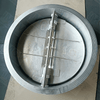
There are three common connection types for marine butterfly valves, each with different features and typical applications:
|
Connection Type |
Features |
Typical Applications |
|
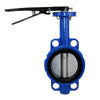
Compact structure, light weight, and lower cost |
Seawater cooling, ballast water, HVAC |
|
|
Supports maintenance or removal on one side of the pipeline |
Ship repair pipelines, sectional maintenance systems |
|
|
Higher pressure capacity and better connection stability |
Fire fighting systems, offshore platforms, high-reliability pipelines |

Material Selection for Marine Butterfly Valves
Compared with ordinary industrial conditions, marine environments require butterfly valves to have much higher corrosion resistance. Material selection is therefore one of the most important factors when choosing marine butterfly valves.
1. Body Material
|
Material |
Advantages |
Typical Applications |
|
Ductile iron + epoxy coating |
Good strength and lower cost, suitable for low- and medium-pressure applications |
Seawater cooling, HVAC, general seawater systems |
|
Carbon steel WCB |
High mechanical strength and good pressure resistance, but requires anti-corrosion coating |
Higher-pressure systems, offshore platforms |
|
Stainless steel CF8/CF8M (304/316) |
Good corrosion resistance; 316 offers better resistance to chloride ions |
Fresh water systems, corrosive media |
|
Aluminum bronze |
Excellent seawater corrosion resistance, good resistance to galvanic corrosion and marine growth |
Seawater cooling, ballast water, offshore platforms |
2. Disc Materials
- The disc is in direct contact with the medium, so corrosion resistance is especially important.
- Common disc materials for marine butterfly valves include SS316, aluminum bronze, duplex stainless steel, and nickel aluminum bronze.
- For systems with long-term seawater exposure, aluminum bronze or duplex stainless steel is usually preferred.
3. Stem Materials
- The stem needs to have both mechanical strength and corrosion resistance. Common materials include SS410, SS420, SS431, SS316, and duplex stainless steel.
- In seawater environments, stainless steel and duplex stainless steel are usually more reliable than ordinary carbon steel.
|
Material |
Suitable Media |
Notes |
|
EPDM |
Seawater, cooling water, HVAC |
The most commonly used option, with good water resistance |
|
PTFE |
Highly corrosive chemicals |
Excellent corrosion resistance |
|
Metal seat |
High-temperature, high-pressure, and fire-safe applications |
Sealing performance is usually lower than soft-seated designs |
Recommended Materials for Different Marine Systems
|
Marine System |
Recommended Materials |
|
Seawater cooling system |
Aluminum bronze disc + EPDM seat |
|
Ballast water system |
Duplex stainless steel disc + EPDM seat |
|
Marine HVAC system |
Ductile iron body + EPDM seat |
|
Fire fighting system |
Ductile iron body + epoxy coating + fire-safe design |
|
Desalination system |
Duplex stainless steel + EPDM |
The above configurations are for general reference only. The final selection should be confirmed based on the medium composition, pressure rating, temperature, flange standard, classification society requirements, and project technical specifications.
Marine Classification Society Certifications
In marine and offshore projects, whether a butterfly valve needs classification society certification usually depends on the vessel type, installation system, project specifications, and shipowner requirements. Common classification societies include CCS, DNV, ABS, LR, BV, NK, and KR.
For critical systems, the project may require the valve to have Type Approval, a Product Certificate, or a third-party inspection certificate.
- Type Approval (TA) is usually used to prove that a certain valve model or product series has been approved by a classification society.
- Product Certificate (PC) is more commonly issued for a specific order or batch of products, proving that the supplied valves meet the project requirements.
In addition to classification society certificates, marine butterfly valves often need to be supplied with material certificates and test documents, such as EN 10204 3.1 material certificates, heat number traceability, shell strength test reports, sealing test reports, and other related documents.
For seawater systems, fire fighting systems, and offshore platform projects, these documents are often important references for purchasing and final acceptance.

How to Select the Right Marine Butterfly Valve
When selecting a marine butterfly valve, it is not enough to consider only the valve size and pressure rating. It is recommended to confirm the following key questions:
- Which marine system will the valve be used in?
- Is the medium seawater, fresh water, cooling water, oily wastewater, or a chemical medium?
- Will the valve be exposed to seawater for a long time?
- What flange standard is required?
- Is classification society certification required?
- Does the valve need a handle, worm gear, electric actuator, pneumatic actuator, or hydraulic actuator?
- Are material certificates, test reports, or third-party inspection required?
Only after these details are clearly confirmed can the right valve body, disc, stem, seat, and actuator be selected.
In marine and offshore projects, the reliability of a butterfly valve often depends on whether the selection is correct. Therefore, when choosing a marine butterfly valve, materials, seat type, actuator, testing standards, and classification society documents should all be reviewed together, instead of only comparing size, pressure, and price.
Union Valve can provide suitable butterfly valve selection advice and product solutions according to your marine system. If you are selecting butterfly valves for a marine or offshore project, please contact us for technical support.
FAQ
What is the best material for marine butterfly valves?
For long-term seawater service, aluminum bronze, nickel aluminum bronze, duplex stainless steel, and super duplex stainless steel are usually better choices for wetted parts.
What certificates are required for marine butterfly valves?
Common documents include Type Approval, Product Certificate, EN 10204 3.1 material certificate, pressure test report, seat leakage test report, and third-party inspection report if required.
Related Articles:
- Choosing the Right Butterfly Valve for Seawater Desalination
- How to Select Butterfly Valves for Chilled Water Systems
- What Valves Are Used in HVAC Cooling Systems
- What Valves Are Used in AI Data Center Cooling Systems