 English
Swing Check Valve vs Dual Plate: Which to Choose?
Swing check valves and dual plate check valves are both commonly used in piping systems to prevent reverse flow. Although both types serve the same basic purpose of stopping backflow, engineers and purchasers often need to select the more suitable valve type based on different system requirements.
Proper check valve selection requires a comprehensive evaluation of pipeline conditions, operating requirements, installation environment, and project specifications. This article compares the key differences between swing check valves and dual plate check valves, helping you understand the design characteristics of both types and make a better choice for your application.
Basic Design Differences Between Swing and Dual Plate Check Valves
Swing Check Valve
A swing check valve uses a single disc design, where the disc is mounted inside the valve body through a hinge shaft.
- When the medium flows in the forward direction, the fluid pressure pushes the disc open by rotating it around the hinge shaft, allowing the medium to pass through.
- When the flow stops or reverse flow occurs, the disc returns to the seat position under its own weight, preventing the medium from flowing backward.
This design provides a relatively smooth flow passage with low flow resistance, making it suitable for large-diameter pipeline applications.
However, because the disc needs to rotate through a certain angle during closing, the movement distance is relatively long, resulting in a slower closing speed.

Dual Plate Check Valve
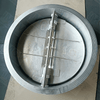
A dual plate check valve uses a two-disc design, consisting of two semi-circular discs mounted on a central shaft and assisted by springs for closing.
- When the medium flows in the forward direction, the fluid pressure pushes the two discs open.
- When the flow velocity decreases or reverse flow begins to occur, the springs help the discs quickly return to the closed position.
Compared with swing check valves, dual plate check valves have a more compact design and shorter disc travel distance. This allows faster closing response and helps reduce the risk of backflow and water hammer.

Swing Check Valve vs Dual Plate Check Valve: Key Differences
Although both types of check valves are designed to prevent reverse flow in pipelines, their different structural designs result in differences in operating performance and suitable applications.
|
Comparison Item |
Swing Check Valve |
Dual Plate Check Valve |
|
Disc Structure |
Single disc connected by a hinge shaft |
Two semi-circular discs connected through a central shaft |
|
Closing Mechanism |
Mainly relies on disc weight and reverse flow pressure for closing |
Uses spring-assisted closing |
|
Closing Speed |
Relatively slower due to longer disc travel distance |
Faster due to shorter disc movement distance |
|
Water Hammer Control |
Moderate; higher risk of water hammer during rapid flow changes |
Better; helps reduce reverse flow impact |
|
Flow Resistance |
Smooth flow passage when fully open, resulting in lower pressure loss |
Slightly higher flow resistance because the discs remain within the flow path |
|
Installation Space |
Longer structure, requiring more installation space |
Compact design with smaller space requirements |
|
Weight |
Generally heavier, especially for large-diameter valves |
Lighter weight and easier installation |
|
Maintenance |
Simple structure, easy inspection and maintenance |
Compact structure but with more internal components |
|
Cost |
Generally lower cost |
Generally higher cost |
Performance Comparison: Which One Performs Better?
There is no absolute winner between swing check valves and dual plate check valves.
Swing check valves focus more on low flow resistance, simple structure, and long-term reliable operation, while dual plate check valves are designed for faster closing, reduced water hammer risk, and space-saving installation.
In actual applications, the selection should be based on the system requirements for pressure loss, closing speed, installation conditions, and operational stability.
1.Pressure Loss and Flow Resistance
The pressure loss of a check valve directly affects pump energy consumption and overall system efficiency. The performance comparison between the two types is as follows:
- Swing Check Valve
When fully open, the disc rotates above the flow passage, providing a large flow area. The medium can pass through smoothly with relatively low flow resistance.
Best suited for:
Large-diameter water transmission systems, long-distance pipelines, and water treatment projects where pressure loss is a critical consideration.
- Dual Plate Check Valve
The two discs are positioned within the flow passage, causing some flow disturbance during operation. As a result, the flow resistance is slightly higher than that of a swing check valve.
Compensating advantages:
Compact face-to-face length and lightweight design, helping save installation space and reduce overall installation costs.
Selection Recommendation:
If the priority is to minimize pressure loss, especially in large-diameter and continuously operating water transmission systems, a swing check valve is usually the more suitable choice.

2.Closing Speed and Water Hammer
Closing speed is one of the most important performance differences between swing check valves and dual plate check valves.
- Swing Check Valve
The disc returns to the seat position by rotating around the hinge shaft under its own weight. Due to the effects of disc weight and inertia, the valve may not close immediately when the flow velocity changes rapidly.
Risk conditions:
Sudden pump shutdown, rapid flow fluctuations, and long-distance pipelines may result in reverse flow and noticeable water hammer.
- Dual Plate Check Valve
A dual plate check valve uses a spring-assisted closing mechanism. Since the disc travel distance is shorter, it can close faster when the flow velocity decreases.
Advantages in:
Pump discharge lines, systems with frequent pump start-stop cycles, and projects with strict water hammer control requirements.
Selection Recommendation:
If the project focuses on reducing water hammer and achieving faster response, a dual plate check valve is usually the better choice.

3.Installation Space and Maintenance
In addition to performance factors, installation conditions are also important considerations when selecting a check valve.
Swing Check Valve
-
Installation:
The valve has a longer face-to-face length and is heavier in large sizes, so it requires more installation space. It is mainly installed in horizontal pipelines, while vertical installation is generally limited to upward flow.
-
Maintenance:
With a simple structure and fewer internal components, inspection and maintenance are relatively convenient during long-term operation.
Dual Plate Check Valve
-
Installation:
The wafer-style design has a shorter face-to-face length and lighter weight, requiring less installation space. It is suitable for compact piping systems and can usually be installed in both horizontal and vertical pipelines, depending on the valve design.
-
Maintenance:
The internal spring mechanism and dual-disc shaft make the structure more complex, resulting in slightly higher maintenance requirements.
Selection Recommendation:
If installation space is limited, a dual plate check valve is usually preferred. If structural simplicity and ease of maintenance are the main priorities, a swing check valve may be more suitable.

How to Choose Between Swing and Dual Plate Check Valves?
No single type of check valve is suitable for all operating conditions. The right choice should be based on the actual system requirements and operating environment.
Suitable Applications for Swing Check Valves:
- Large pipeline sizes
- Systems where pressure loss needs to be minimized
- Applications requiring a simple and reliable design
- Projects where easy maintenance is important
- Applications with a stronger focus on cost-effectiveness
Suitable Applications for Dual Plate Check Valves:
- Systems requiring fast closing performance
- Applications with higher water hammer risks
- Installations with limited space
- Projects where lower valve weight is preferred
- Pipelines with frequent flow variations
Swing check valves and dual plate check valves each have their own advantages, and there is no single “best choice” suitable for all operating conditions.
By considering pipeline conditions, medium characteristics, operating requirements, and installation environment, the right valve selection can maximize performance and ensure the long-term, safe, and stable operation of the piping system.
As a professional valve manufacturer, Union Valve provides swing check valves, dual plate check valves, and other water system valve solutions. Based on pipeline size, medium conditions, pressure rating, and operating requirements, we help customers select the most suitable valve products for their applications.Please feel free to contact us if you have any further questions.
Related Articles:
- How to Select the Right Valves for Pump Stations
- What Is a Swing Check Valve Used For
- Gate and Check Valves: Clear Comparison Guide
- How to Choose the Right Check Valve for Your System
- One Way Valve vs Check Valve: Differences, Uses, and Selection Guide